
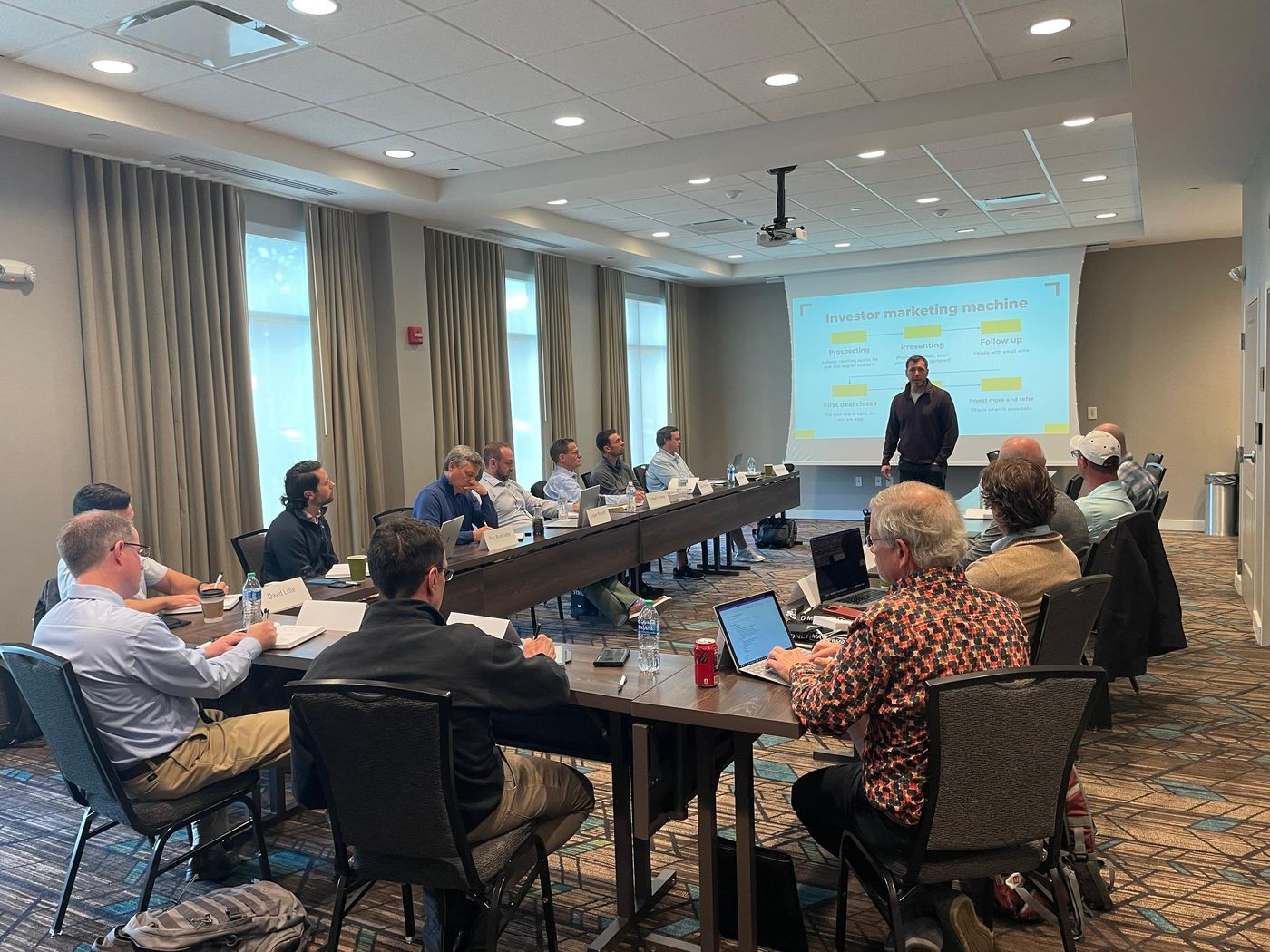
Most lenders dream about hitting that first $10 million portfolio milestone but never actually map out what it takes to get there. After building multiple $10 million portfolios across many East Coast states, I can tell you EXACTLY what moves the needle.
This isn’t theory. I’m pulling back the curtain on the actual numbers, systems, and decisions that took us from zero to $10 million multiple times.
What You’ll Learn:
- Business Planning: The Real Numbers Behind $10 Million
- Lead Flow Systems That Actually Convert
- Risk Management Without Paralysis
- Capital Structure That Scales
- The Only 2 Hires You Need
- Technology Stack That Won’t Break
Business Planning: The Real Numbers Behind $10 Million
Forget the spreadsheet fantasies. Here’s what a real $10 million portfolio looks like when you’re in the trenches.
You’re looking at 57 loans with an average loan amount of $175,000. That’s your target. Not 100 tiny deals that drain your time. Not 10 massive deals that could sink you.
The math is simple but most people get it wrong. At 3 points origination, 12.99% interest, and a $995 funding fee per loan, you’re generating $300,000 in origination fees annually if you turn the portfolio once. Turn it 1.5 times (which is realistic), and you’re looking at $450,000.
Here’s what catches new lenders off guard: the portfolio doesn’t fill overnight. It took us about three years to hit our first $10 million. The first six months, you’re just originating with no payoffs coming in. Then the machine starts humming.
The Revenue Breakdown That Actually Matters
If you’re using 100% other people’s money at a 10% cost and lending at 12.99%, that 2.99% spread generates $300,000 annually on $10 million deployed. Add your origination fees, funding fees, and inspection fees ($195 per inspection, paid upfront), and you’re looking at real revenue.
One critical piece most lenders miss: 50-60% of your borrowers will be repeat customers if you treat them right. Every two deals turns into a third deal. That’s not wishful thinking. That’s our actual data after 4,000+ loans.
VIP Access: How Would You Like Us To Hold You By The Hand As You Start (Or Grow) Your Own Hard Money Lending Business! Get access to our Monthly Coaching Calls, the complete Hard Money Masterclass (worth $4,997), and see the exact deal structures we use. Join the 2,600+ lenders already inside Hard Money Mastermind.
Lead Flow Systems That Actually Convert
You need volume to hit $10 million. Starting thinking like a marketing company. We consider any conversation with an active real estate investor a qualified lead and focus on converting qualified leads into clients. The secret isn’t just more leads, but better conversations with the RIGHT borrowers.
Online vs. Offline: The Truth Nobody Talks About
Everyone’s chasing digital leads, but my highest-quality borrowers still come from offline networking. Local REIA meetings, in person auctions, Meetup events, title company relationships etc.. One coffee meeting beats 100 cold emails.
That said, digital works when you do it right. We have a CPA of around $100 per loan application from paid search and social, Connected Investor leads run about $30 each and BiggerPockets leads cost us about $50-60 per qualified conversation.
I built an automated system using Zapier that parses emails, dumps them into our CRM, and triggers follow-up sequences. No manual data entry. No dropped leads. Just conversations.
The Lead Metrics That Matter
Track these numbers religiously: Cost per funded loan, not cost per lead. Source of your best repeat borrowers, not just first-time borrowers. Average days from first contact to funding.
Our email list of 40,000 local investors generates more repeat business than any paid advertising channel. Build your list immediately and start adding to it daily.
Risk Management Without Paralysis
Every loan needs to be evaluated by the 4 C’s. Collateral, Character, Capacity and Credit. We DO valuations, we DO chat & meet with borrowers, we DO verify assets and past projects and we DO pull credit. You shouldn’t be doing deals that are risky.
The conservative approach that keeps you in business: 65% LTV maximum (not the 70-75% cowboys pitch). 30-90 day comp window for valuations. Budget for 90-180 day holds, not the 60-90 days borrowers promise.
Documentation That Protects You
Get MLS comps through a licensed professional for accurate comps. Use BPO, CMA or Appraisals when needed or if comps feel off. Pull public records for additional data.
Access land records for past deeds, deeds of trusts or mortgages and for title chains.
Verify appropriate entity docs. Operating agreements, certificate of good standing, articles of organization/incorporation and EIN.
Ask for bank/asset statements when needed or even income docs and leases on some deals.
Personal property inspections matter, especially in your first few years. I still personally inspect properties on larger deals.
Capital Structure That Scales
The biggest mistake at this level? Having too few capital investors. When one or two investors control your capital, they control your business. They’ll push for lower LTVs, cherry-pick deals, and eventually dictate your underwriting.
I learned this the hard way when one investor funding a large percentage of my deals started demanding changes. Spread your risk across at least 10-15 capital sources.
The Capital Problem Nobody Warns You About
Around $7-8 million deployed, capital becomes easier to find than good deals. Sounds like a great problem until you’re sitting on idle money costing you 10% annually.
The solution? Set deployment expectations upfront. Tell investors you’ll deploy within 30-45 days, not immediately. Keep a pipeline of pre-approved borrowers ready for when capital comes in.
Self-directed IRA money works but comes with strings. The complexities often aren’t worth it unless it’s $100,000+. Smaller amounts create more headaches than revenue.
Ready to learn the exact systems that built our $50,000,000 private lending empire? Inside Hard Money Mastermind, you’ll get our complete underwriting matrix, capital raising templates, and join live monthly coaching where we break down real deals. See what 2,600+ successful lenders already know.
The Only 2 Hires You Need
At $10 million, you can’t do everything yourself. But you don’t need a massive team either.
Your first hire: A processor who handles paperwork, insurance tracking, and basic borrower communication. Pay them $50,000-60,000 annually. They’ll free up 20 hours of your week for actual deal-making.
Your second hire: A part-time bookkeeper or accountant. Not your cousin who “knows QuickBooks.” A real professional who understands lending. Budget $1,000-2,000 monthly for this.
What About Everything Else?
Outsource inspections to local contractors at $100 per visit. Use virtual assistants for data entry and CRM management at $5-10 per hour. Keep your doc prep with specialized attorneys who charge $795-895 per loan.
Don’t hire salespeople yet. At this level, borrowers want to talk to the decision-maker. That’s you.
Vacation? You’ll need systems and people. Set up automated responses, have your processor handle routine requests, and keep your phone for true emergencies only. Between your small team most new deals can still be done and challenges overcome.
Technology Stack That Won’t Break
You need real loan servicing software sooner than you think. If you are serious about this business, get something you can grow into. Spreadsheets work for a while but eventually will be too cumbersome. We have used TheMortgageOffice.com forever but Lendrsoftware.com and MortgageAutomator.com are popular solutions too.
The non-negotiable tech stack includes: Loan origination and servicing software ($500-2,000 monthly), CRM for lead management (Go High Level, HubSpot or similar), QuickBooks for accounting, and Zapier for automation. If you don’t have a way to send out email broadcast.. Make sure to prioritize that asap (many options available. Mail chimp, constant contact etc..)
The Hidden Software Costs
Budget $2,000-3,000 monthly for technology once you hit $10 million. That sounds high until you calculate the cost of one missed payment or lost lead.
Don’t cheap out on email parsing and automation. The $100/month for Zapier saves me 10 hours weekly in manual data entry. That’s 500 hours annually.
Document storage matters. Use cloud-based systems with proper backup. Losing loan documents isn’t just embarrassing. It’s potentially catastrophic.
The Monthly P&L Reality Check
Here’s what nobody shows you – the actual monthly overhead at $10 million deployed. You’re looking at $15,000-20,000 monthly in real expenses.
Marketing: $3,000-5,000. Salaries: $8,000-10,000. Software: $2,000-3,000. Professional services: $2,000-3,000. Office and miscellaneous: $2,000.
Yes, that’s $180,000-240,000 annually in overhead. But against $800,000 in revenue, you’re still netting $600,000. Those are real numbers (assuming 10% cost of capital)
The Truth About Timeline
Building to $10 million portfolio is very reasonable to get to in about 3 years or so. Year one is about learning and spending a lot of sweat equity time in the business. Start slow.. Year two is about systems and reputation. Year three is when the MACHINE really starts working.
The pattern is predictable. First six months: all origination, no payoffs. Months 7-12: sporadic payoffs, building momentum. Year two: daily payoffs matching daily originations. Year three and beyond: true portfolio velocity.
Most lenders start struggling in year two when things get hard. The ones who push through hit $10 million and wonder why they ever doubted it.
You can grow quicker than this BUT it’s important to watch loans cycle through to ensure you are writing good loans from the beginning without many defaults.
Your Next Move
$10 million isn’t a dream. It’s a series of deliberate decisions executed consistently. Start with the math, build the systems, make the hires, and stay conservative on underwriting.
The difference between lenders stuck at $2 million and those pushing past $10 million? The stuck ones are still trying to do everything themselves. The successful ones built systems that work without them.
Which one will you be?
Join the 2,600+ lenders inside Hard Money Mastermind who are actively building, scaling, and perfecting their lending businesses. Get immediate access to our complete Hard Money Masterclass, monthly live coaching calls with Chris and me, plus the exact templates and systems we use daily. This is the mastermind we wished existed when we started. Start your journey to $10 million here. www.HardMoneyMastermind.com
DISCLAIMER: This article is for informational and educational purposes only and should not be construed as investment advice. Real estate investing and hard money lending involves risk, including the potential loss of principal. Past performance does not guarantee future results. Market conditions can change rapidly, and all statistics cited are subject to change. Always conduct your own due diligence and consult with licensed professionals including real estate agents, attorneys, accountants, and financial advisors before making any investment decisions. The authors and characters involved in this article are not responsible for any investment decisions made based on the information provided in this article.